Die Casting Machine FAQ
Abstract:
YIZUMI explains die casting machine basics, hot and cold chamber options, selection, cost, maintenance, scrap reduction, cycle time, automation, spare parts, and high-pressure casting performance.
Q1: How does a die casting machine work?
A: A die casting machine works by clamping a reusable steel die closed and injecting molten metal into the mold cavity under high pressure. The metal quickly fills the shape of the die, cools, and solidifies into a finished casting. After cooling, the die opens and ejector pins push the part out. The cycle then repeats, allowing manufacturers to produce large volumes of consistent metal parts with complex shapes and fine details.
Q2. What are the main types of die casting machines?
A: Hot chamber die casting machines are mainly used for low-melting-point metals such as zinc and magnesium. The injection system is connected to the molten metal, which helps achieve fast cycle times and efficient mass production.
Cold chamber die casting machines are mainly used for higher-melting-point metals such as aluminum and copper alloys. The metal is melted in a separate furnace and then transferred into the injection sleeve before being injected into the die.
Depending on production needs, die casting machines may also be designed as horizontal, vertical, two-platen, ultra-large, or fully automated die casting systems.
Q3. What is the difference between hot chamber and cold chamber die casting machines?
A: The main difference is how molten metal is supplied to the machine. In a hot chamber die casting machine, the metal is melted and kept inside the machine, then injected directly into the die. This makes it faster and more suitable for low-melting-point alloys such as zinc, tin, lead, and some magnesium alloys.
In a cold chamber die casting machine, the metal is melted in a separate furnace and then poured into the shot sleeve before injection. This process is better for higher-melting-point alloys such as aluminum, copper-based alloys, and magnesium alloys, especially when producing larger, stronger, or more complex parts.
Q4. How to Choose the Right Die Casting Machine?
A: Choose a die casting machine based on the alloy, part size, mold design, shot weight and production target. Hot chamber machines are usually more efficient for zinc and suitable magnesium parts, while cold chamber machines are better for aluminum, copper-based alloys and larger structural components.
Before final selection, check the required clamping force, shot capacity, projected area, platen size, tie-bar distance, die thickness range, opening stroke and ejector stroke. For high-volume production, also consider cycle time, energy use, automation compatibility, process stability and maintenance access.
Q5: How much does a die casting machine cost?
A: The cost of a die casting machine depends on the machine type, locking force, alloy, automation level and production requirements. As a general market reference, industrial die casting machines usually start from tens of thousands of dollars, while high-tonnage or fully automated cold chamber systems can reach hundreds of thousands to several million dollars.
For a more accurate price, the machine should be selected based on the part size, material, projected area, shot weight, die dimensions and required output. The total investment may also include dies, furnace, ladle, sprayer, extractor or robot, trim press and other peripheral equipment. YIZUMI can recommend a suitable die casting machine and cell configuration according to your production needs.
Q6. Is die casting suitable for mass production?
A: Yes. Die casting is highly suitable for mass production because it forms metal parts quickly, accurately, and repeatedly under high pressure. Once the steel die is made, each cycle can produce consistent parts with smooth surfaces and minimal secondary processing.
With YIZUMI die casting machines and intelligent die casting cells, manufacturers can improve cycle efficiency, process stability, and automated production from casting to take-out, spraying, cooling, trimming, and conveying.
Q7. How often should a die casting machine be maintained?
A: A die casting machine should be checked every shift and maintained based on operating hours and casting cycles. Daily checks usually include lubrication, hydraulic oil, cooling water, safety devices, leaks, and abnormal noise.
For continuous production, maintenance should be more frequent. Wear parts such as plunger tips, shot sleeves, ejector pins, seals, bushings, and tie bars should be inspected regularly, with a full annual service for the hydraulic, clamping, and safety systems. YIZUMI’s maintenance reminders and remote diagnosis support help users plan maintenance before downtime occurs.
Q8. What should I compare before buying a die casting machine?
A: Before buying a die casting machine, compare it against your actual casting job, not just price or tonnage. Check alloy type, hot or cold chamber process, clamping force, shot weight, die fit, injection stability and cycle time. Zinc often suits hot chamber machines, while aluminum typically needs cold chamber equipment.
Also compare long-term value: energy use, automation readiness, maintenance access, spare parts, local service and uptime. The right machine should reduce scrap, keep quality stable and support future production growth.
Q9. How can die casting machines reduce the scrap rate?
A: Die casting machines reduce scrap by controlling each shot more precisely: use a slow first-stage shot to push air out of the sleeve, switch to high-speed filling at the right position, and apply intensification pressure immediately after the cavity is filled. This helps reduce porosity, cold shuts, shrinkage, and short shots.
Scrap can be further cut by keeping die temperature stable, using vacuum and proper venting, checking clamping force to stop flash, and recording pressure, speed, and position curves. With YIZUMI’s closed-loop injection and digital control, teams can spot drift early and correct the process before bad parts repeat.
Q10. How can the service life of a die-casting machine be extended?
A: Extend a die-casting machine’s life by making maintenance a production habit, not a repair task. Check hydraulic oil, filters, cooling water, lubrication points, tie bars, plunger tips and shot sleeves on schedule. Fix leaks, noise or unstable pressure early, before they damage pumps or the clamping unit.
Run the machine within the right process window. Preheat dies, avoid sharp temperature swings, and use only the injection speed, pressure and hold time the casting needs. With YIZUMI’s maintenance reminders and component monitoring, daily data can become early action that reduces downtime.
Q11. What machine specifications matter most in high-pressure die casting?
A: In high-pressure die casting, the most important machine specifications are clamping force, shot capacity, injection speed and pressure, platen size, tie-bar spacing, die height, and opening/ejection stroke. These determine whether the die can be held shut, filled before the metal cools, and opened safely for part removal.
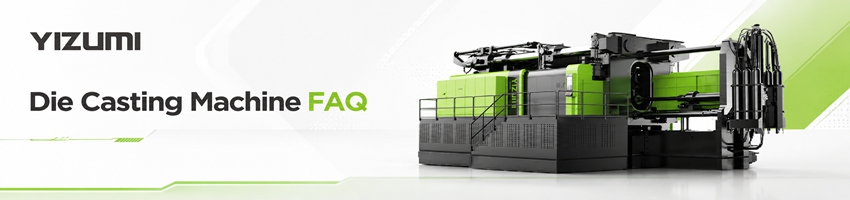
YIZUMI’s die casting lineup shows why tonnage alone is not enough. A better choice balances die fit, metal volume, fast and repeatable injection, rigid platens, precise clamping, and automation readiness, so quality stays consistent from trial casting to mass production.
Q12. How can a die casting machine help reduce flash?
A: A die casting machine reduces flash by keeping the die shut and the metal flow stable. The key is not simply using more tonnage, but matching clamping force with projected area, cavity pressure and die condition so molten metal cannot escape through the parting line.
YIZUMI machines support this with rigid platens, stable locking, automatic die height/locking force settings and real time closed loop injection control. By smoothing speed and pressure especially near the end of filling and keeping temperature under control, the process cuts pressure spikes, trimming work and die wear.
Q13. How can die casting cycle times be reduced without sacrificing quality?
A: Reducing die casting cycle time starts with the die, not the stopwatch. Keep the mold in a stable thermal window by improving cooling flow, removing hot spots, controlling spray volume and designing uniform walls. Cutting cooling time blindly trades seconds for porosity, distortion or shorter die life.
Then remove idle time. Automate spraying and extraction, and tune shot speed, pressure, changeover and hold time from real data. YIZUMI’s LEAP platform, Yi-Cast closed-loop injection and ORCA-HMI help keep every shot repeatable, so higher output comes from a stable process.
Q14. What are the benefits of automatic ladling in die casting?
A: Automatic ladling improves die casting at the most sensitive moment: filling the shot sleeve. By dosing and pouring molten metal with repeatable volume, angle and timing, it stabilizes shot weight, reduces turbulence, and helps cut porosity, short shots and scrap.
In an intelligent die casting cell, YIZUMI’s integrated ladling, spraying and extraction approach turns ladling into part of the whole process rhythm. The benefit is not only less manual work, but safer molten-metal handling, steadier cycles, higher yield and more predictable casting quality.
Q15. What spare parts should be kept on hand for a die casting machine?
A: Keep a small stock of fast-wearing shot-end parts first: plunger tips, piston/wear rings, shot sleeves, nozzles, seals, hoses and cooling fittings. For hot-chamber machines, add goosenecks, crucibles, pistons, nozzle tips and thermocouples.
Also keep downtime-critical hydraulic, electrical and cell spares: filter elements, O-rings, valves, sensors, fuses, relays, PLC/I/O modules, ejector pins, limit switches, spray nozzles and robot grippers. Match quantities to tonnage, alloy, shot count and lead time.