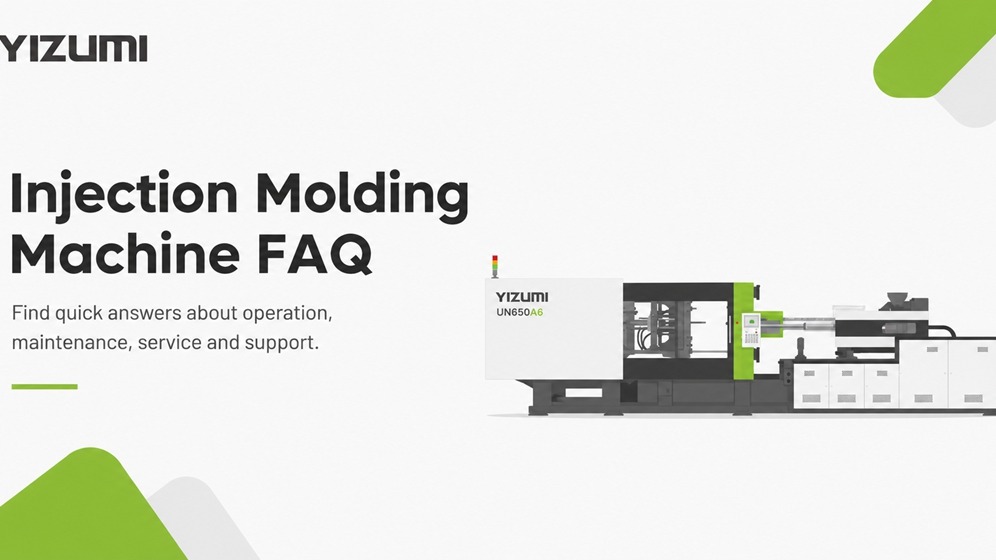
Injection Molding Machine FAQ
Abstract:
YIZUMI answers common injection molding machine questions, covering operation, model selection, clamping force, cycle time, materials, maintenance, costs, tonnage, screw choice, and precision factors.
Q1. How does an injection molding machine work?
A: An injection molding machine works by feeding plastic pellets into a heated barrel, where a rotating screw melts and pushes the material forward. Once the plastic becomes molten, the screw injects it through a nozzle into a closed mold cavity. The clamping unit keeps the mold tightly closed during injection, while holding pressure helps the part fill completely and reduces shrinkage. After the plastic cools and solidifies inside the mold, the mold opens and ejector pins or automation remove the finished part.
Q2: How do I choose the right injection molding machine?
A: Choose an injection molding machine based on your part size, mold structure, plastic material, and production goals. Check the required clamping force, shot size, platen size, tie-bar spacing, daylight, and ejector stroke first. Then select the right machine type, such as hydraulic, electric, two-platen, high-speed, or multi-component, according to your needs for precision, cycle time, energy efficiency, part complexity, and budget.
Q3: What Is Clamping Force in Injection Molding Machines?
A: Clamping force in injection molding machines is the force that keeps the mold halves closed while molten plastic is injected under pressure. It prevents the mold from opening, helping avoid flash, dimensional errors, unstable part weight, and mold damage. The required force is mainly based on the part’s projected area and cavity pressure; too little force causes defects, while too much can increase mold wear, machine stress, and energy use.
Q4: What are the main types of injection molding machines?
A: Injection molding machines are mainly classified as hydraulic, electric, and hybrid. Hydraulic machines offer strong clamping force for large parts, electric machines provide precise and energy-saving production, and hybrid machines combine power, speed, and accuracy. They can also be grouped by structure or application, such as horizontal, vertical, two-platen, toggle-clamping, high-speed, multi-component, and special-purpose machines.
Q5: Is a servo injection molding machine more energy-saving?
A: Yes. A servo injection molding machine can significantly reduce power consumption compared with a conventional hydraulic machine. Depending on the molding process and operating conditions, energy savings can reach about 30%–80%.
Its servo motor supplies power only when the machine needs pressure or movement, instead of running continuously. This helps reduce energy waste, oil temperature, noise, cooling demand, and long-term maintenance costs.
Q6: What is the injection molding cycle?
A: The cycle time of an injection molding machine is the time needed to complete one full molding cycle and produce one finished part. It usually includes injection, holding, cooling, mold opening, part ejection, and mold closing.
Q7: What is the cycle time of an injection molding machine?
A: Most injection molding cycle times range from about 10 seconds to over 2 minutes, depending on the part design, wall thickness, material, mold cooling efficiency, cavity layout, injection speed, clamping response, and ejection method. Cooling usually takes the longest time, especially for thick or large parts. For high-speed applications such as packaging, caps, medical disposables, and 3C components, fast machine response, short dry cycle time, stable control, and automation help improve overall production efficiency while maintaining consistent part quality.
Q8: What materials can be used in injection molding machines?
A: Injection molding machines are mainly used for thermoplastics such as ABS, PP, PE, PC, PA, PET, PVC, POM, PMMA and PBT. With the right machine and process setup, they can also handle thermosets, Bakelite/BMC, rubber, TPE/TPU, liquid silicone rubber (LSR), reinforced plastics and metal injection molding feedstocks. Material selection should be based on the final part’s strength, flexibility, heat resistance, chemical resistance, appearance and production needs.
Q9: How often should an injection molding machine be maintained?
A: An injection molding machine should be checked daily and maintained based on operating hours. Daily checks include oil level, leaks, lubrication, abnormal noise, and safety devices. Key parts such as the screw, barrel, oil cooler, filters, mold surface, and electrical components should be inspected monthly or every 500–1,000 hours. A full maintenance check is recommended at least once a year, or more often for high-volume production or abrasive materials.
Q10: How much does an injection molding machine cost?
A: An injection molding machine can cost from a few thousand dollars for a small unit to over $500,000 for a large industrial machine. The final price depends on clamping force, injection capacity, drive system, automation level, mold requirements, and application needs.
YIZUMI offers hydraulic, electric, high-speed, two-platen, multi-component, vertical, and special-purpose injection molding machines for different industries. For an accurate quotation, share your part drawing, material, mold information, output target, and production requirements with YIZUMI.
Q11: What is the best injection molding machine for small plastic parts?
A: For small plastic parts, the best choice is usually a precision electric injection molding machine matched to the part weight, mold size, material, and required clamping force.
If the parts require tight tolerances, stable dimensions, clean production, or high repeatability, the YIZUMI FF Series Electric Injection Molding Machine is a suitable option. It offers precise process control and stable molding performance for small components such as electronic parts, connectors, medical parts, gears, clips, and thin-wall products.
Q12. How do you select the right type of screw for an injection molding machine?
A: Choose the screw based on the resin, filler content, shot size, and melt quality needs. General-purpose screws work well for common plastics such as PP, PE, ABS, and PS. Heat-sensitive materials need a low-shear screw to reduce degradation. Glass-filled or abrasive materials should use a hardened or bimetallic screw for better wear resistance. Also check the screw diameter, L/D ratio, compression ratio, and plasticizing stability before final selection.
Q13. What factors affect the precision of injection molding machines?
A: The precision of an injection molding machine depends on stable clamping, accurate injection speed and pressure control, consistent temperature control, good plasticizing quality, material stability, mold condition, cooling efficiency, and the control system. Stable clamping helps keep the mold closed and aligned. Accurate injection and holding pressure improve filling, part weight, and shrinkage consistency. Proper barrel and mold temperature control, balanced cooling, dry materials, and a well-maintained mold help reduce flash, warpage, sink marks, and dimensional variation.
Q14: How to choose the tonnage of an injection molding machine?
A: Choose the tonnage by calculating the part’s total projected area, including all cavities and runners, then multiply it by the material clamp factor and add a 10–20% safety margin. Materials such as PP and PE usually need lower clamping force, while ABS, PC, PA/Nylon, glass-filled or thin-wall parts often require higher tonnage. The right machine should prevent flash and unstable dimensions without being oversized; also confirm shot size, mold size, tie-bar spacing, opening stroke, injection pressure and speed before final selection.
Q15. What is an injection molding machine?
A: An injection molding machine is industrial equipment used to produce plastic parts by melting plastic resin and injecting it into a mold under pressure. After the plastic cools and solidifies, the mold opens and the finished part is ejected. A typical machine includes an injection unit, a clamping unit, and a mold/ejection system. It is widely used to make high-volume, consistent parts for automotive, medical, electronics, packaging, and consumer products.