Automotive Injection Molding: A Practical Guide to Parts, Materials, Process and Machine Selection
Abstract:
Explore how automotive injection molding shapes interior, exterior, under-the-hood and EV parts, from material choice and defect control to machine selection. See what matters in clamping force, shot weight, mold fit, automation and cost for stable high-volume production.
Automotive injection molding is one of the most important manufacturing methods behind modern vehicle production. From dashboards and door panels to bumpers, lighting housings, connectors, engine covers and EV components, injection molded plastic parts help automakers reduce weight, improve production efficiency and keep part quality consistent at scale.
But for automotive parts manufacturers, the real question is not only “What is injection molding?” It is also:
· Which material should be used for this automotive part?
· What machine size and configuration are suitable?
· How can warpage, flash, short shots and surface defects be avoided?
· What should buyers check before investing in a new injection molding machine?
· How can the production cell support stable mass production, automation and long-term cost control?
This guide explains automotive injection molding from a production and machine selection point of view, helping part manufacturers, molders and equipment buyers make better decisions before launching a new automotive project.
What Is Automotive Injection Molding?
Automotive injection molding is a manufacturing process used to produce plastic vehicle parts by injecting melted resin into a precision mold. After cooling, the finished part is ejected and the cycle repeats for mass production.
It is widely used for dashboards, door panels, bumpers, grilles, mirror housings, lighting components, connectors, engine covers and EV-related plastic parts.
Compared with general plastic molding, automotive injection molding requires stricter control over part strength, dimensional accuracy, surface quality and long-term process stability. A part must not only pass the first mold trial; it must stay consistent through high-volume production.
That is why successful automotive molding depends on the right combination of material, mold design, process control and injection molding machine selection. For manufacturers, the goal is simple: produce qualified parts repeatedly, reduce scrap, maintain cycle time and keep production reliable.
Why Injection Molding Is Widely Used for Automotive Parts
Automotive manufacturers use injection molding because it offers a strong balance of design freedom, production efficiency and material performance.
1. Lightweight part production
Replacing some metal parts with engineered plastics can help reduce vehicle weight. This is especially important for fuel efficiency, EV driving range and overall vehicle performance. Injection molding allows engineers to create lightweight structures with ribs, bosses, clips and integrated mounting features.
2. Consistent quality in mass production
Automotive parts often need to be produced in large quantities with stable dimensions and appearance. A suitable injection molding machine, mold and process window can help maintain repeatability over long production runs.
3. Complex geometry and integrated functions
Injection molding can create parts with snap-fits, ribs, inserts, soft-touch areas, sealing features and decorative surfaces. This can reduce secondary assembly and simplify part design.
4. Cost efficiency at scale
The mold investment can be significant, but once production volume increases, the unit cost can become more competitive. For automotive suppliers, the final cost should be calculated by cost per good part, not only by mold price or machine price.
5. Support for automation
Injection molding machines can be integrated with robots, conveyors, dryers, mold temperature controllers, inspection systems and smart manufacturing platforms. This helps reduce manual handling and improves production stability.
Common Automotive Injection Molded Parts
Automotive injection molding machine covers a wide range of vehicle areas. Each part type has different requirements for material, mold design, machine configuration and process control.
Interior parts
Common interior injection-molded parts include:
· Dashboards
· Door panels
· Center consoles
· Air vents
· Glove boxes
· Cup holders
· Seat belt trim
· Pillar trims
· Switches, buttons and knobs
Interior parts often require good surface finish, low odor, low VOC, scratch resistance and stable color. For large interior panels, warpage control and surface consistency are especially important.
Exterior parts
Common exterior parts include:
· Bumpers
· Grilles
· Fender liners
· Mirror housings
· Spoilers
· Wheel arch trim
· Splash guards
· Lighting housings
Exterior parts are exposed to UV, weather, impact and temperature changes. They often need materials with good impact strength, UV resistance and dimensional stability.
Under-the-hood parts
Typical under-the-hood components include:
· Engine covers
· Air intake components
· Fan shrouds
· Fluid reservoirs
· Battery trays
· Brackets
· Oil and coolant-related housings
These parts may face heat, oil, chemical exposure and vibration. Glass-filled engineering plastics are often used, which means the Injection molding machine’s screw and barrel wear resistance, plasticizing stability and temperature control become more important.
Electrical and electronic components
Automotive electrical parts include:
- · Connector housings
- · Fuse boxes
- · Sensor housings
- · Wire harness clips
- · ECU housings
- · Switch components
These parts usually require precision molding, flash control, electrical insulation and stable dimensions. A high-repeatability injection molding machine is important for this type of application.
EV and hybrid vehicle components
Electric vehicles are increasing demand for plastic parts used in:
· Charging port covers
· High-voltage connector housings
· Battery module components
· Cooling system plastic parts
· Lightweight brackets
· Electrical insulation parts
EV components often require flame retardancy, electrical insulation, thermal stability and tight quality control. For machine buyers, this means material handling, process monitoring and stable repeatability should be considered early.
How the Automotive Injection Molding Process Works
A typical automotive injection molding cycle includes five main stages.
1. Mold clamping
The mold closes and the clamping unit holds it shut during injection. The clamping force must be sufficient to resist cavity pressure. If clamping force is too low, flash may occur. If it is too high, it may increase energy consumption or stress the mold unnecessarily.
2. Plasticizing and injection
Plastic pellets are heated and melted inside the barrel. The screw then pushes molten plastic into the mold cavity. Injection pressure, speed and melt temperature affect filling, surface quality and defect risk.
3. Packing and holding
After the mold cavity is filled, holding pressure is applied to compensate for material shrinkage. Poor packing can cause sink marks, voids or dimension variation. Excessive packing can cause flash, internal stress or ejection problems.
4. Cooling
Cooling is often the longest part of the cycle. Uneven cooling can cause warpage, shrinkage problems and dimensional drift. Mold temperature control is especially important for large automotive panels and precision components.
5. Ejection and part handling
After the part has cooled enough, the mold opens and the ejector system removes the part. For cosmetic or large parts, robotic handling can reduce scratches, deformation and operator-related variation.
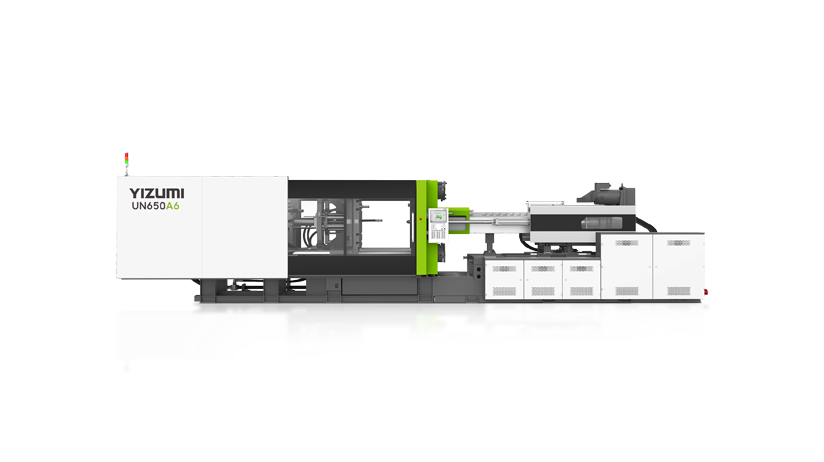
Next-Gen A6 Series Advanced And Intelligent Injection Molding Machine
How to Choose an Injection Molding Machine for Automotive Parts
Choosing an injection molding machine for automotive parts should start with the part itself, not the machine catalog. A good machine choice depends on the part size, mold structure, resin type, production volume and quality requirements.
Here are the key points to check before making a decision:
1. Start with clamping force
Clamping force keeps the mold closed while molten plastic is injected.
For automotive parts, this is especially important because many components have large projected areas or require high injection pressure.
Check:
· Part projected area
· Mold cavity pressure
· Number of cavities
· Material flow behavior
· Safety margin for stable production
If clamping force is too low, the mold may open slightly and cause flash, short shots or dimensional variation. If the machine is too large, it may waste energy and increase operating cost.
2. Match the injection unit to the shot weight
The injection unit must provide enough plastic for the part, runner system and cushion.
A useful rule is to avoid using the machine at the extreme low or high end of its shot capacity. If the barrel is too small, filling may be unstable. If it is too large, the resin may stay in the barrel too long and degrade.
Check:
· Part weight
· Runner weight
· Required cushion
· Resin residence time
· Plasticizing capacity
· Target cycle time
This is important for automotive parts that need consistent appearance, strength and dimensions over long production runs.
3. Choose the right machine type
Different automotive parts need different machine platforms.
| Machine Type | Best Suited For |
| Servo-hydraulic injection molding machine | General automotive parts, interior trim, covers, brackets and medium-size components |
| Electric injection molding machine | Precision parts such as connectors, sensor housings and small components with tight tolerances |
| Two-platen injection molding machine | Large automotive molds, bumpers, dashboards, door panels and large exterior parts |
| Multi-component injection molding machine | Two-color parts, soft-touch parts, seals, lighting parts and integrated functional components |
The best choice is not always the most advanced machine. It is the machine that matches the real production task.
4. Check material compatibility
Automotive parts often use PP, ABS, PC/ABS, PBT, PA, TPE and glass-filled engineering plastics.
Each material places different demands on the machine.
Check:
· Required melt temperature
· Injection pressure
· Drying requirements
· Screw design
· Barrel wear resistance
· Temperature control accuracy
For glass-filled materials, the screw and barrel should be suitable for abrasive resins. For precision or flame-retardant materials, stable temperature control and repeatable injection performance are more important.
5. Confirm the mold fits the machine
A machine may have enough tonnage, but that does not mean the mold will fit.
Before purchase, confirm:
· Tie-bar spacing
· Platen size
· Mold thickness range
· Opening stroke
· Ejection stroke
· Robot access space
· Mold weight capacity
This step is easy to overlook, but it can prevent serious installation and production problems later.
6. Consider cycle time, automation and long-term cost
For automotive production, machine price is only one part of the decision.
Also check:
· Energy consumption
· Cycle time stability
· Scrap rate
· Maintenance cost
· Spare parts support
· Robot and auxiliary equipment integration
· Process data recording
· Service response time
A lower-priced machine may cost more in the long run if it produces unstable parts, consumes more energy or causes frequent downtime.
Cost Factors in Automotive Injection Molding
The cost of automotive injection molding depends on many factors. Buyers should evaluate total production cost instead of only comparing machine prices.
Main cost factors include:
· Mold design and tooling
· Resin type and part weight
· Cycle time
· Number of cavities
· Scrap rate
· Machine energy consumption
· Labor and automation level
· Auxiliary equipment
· Quality inspection
· Maintenance and downtime
· Secondary operations
· Packaging and logistics
A lower-cost machine may not be the lowest-cost solution if it causes higher scrap, unstable cycle time, higher energy use or more downtime.
Why Work With YIZUMI for Automotive Injection Molding Machines?
Automotive injection molding projects are rarely solved by one standard machine. A bumper, a connector housing, an interior trim part and an EV component may all require different clamping force, injection control, mold space, material processing and automation support. YIZUMI offers a broad range of injection molding solutions, including hydraulic, electric, two-platen, multi-component, high-speed, special-purpose and vertical injection molding machines, helping manufacturers choose equipment based on the actual part and production requirements.
Key advantages for automotive parts production:
· Broad machine portfolio
Options for general automotive parts, large molds, precision components, multi-material parts and special molding applications.
· Suitable for auto parts applications
YIZUMI lists auto parts as one of its injection molding application areas, making it relevant for interior, exterior, under-the-hood and EV-related plastic components.
· Flexible machine selection
Two-platen machines can support large automotive molds, electric machines fit precision parts, and multi-component machines are useful for two-color, soft-touch or integrated functional parts.
· Support for production efficiency
Machine choice can be matched with cycle time, mold size, material type, automation needs and long-term production stability.
· Clear path to project consultation
Manufacturers can share part drawings, material, mold size and output targets with YIZUMI to get a more suitable machine recommendation.
Conclusion
Automotive injection molding produces interior, exterior, under-the-hood and EV plastic parts with stable quality at scale. Success depends on choosing the right resin, mold design, process settings and machine. Manufacturers should match clamping force, shot weight, mold size, injection control and automation needs to the actual part, while controlling defects such as warpage, flash and short shots to lower cost per qualified part.
FAQ
Q1. What is automotive injection molding?
A: Automotive injection molding is the process of injecting melted plastic resin into a precision mold to produce vehicle parts repeatedly and efficiently.
Q2. What materials are used for automotive injection molded parts?
A: Common materials include PP, ABS, PC/ABS, PBT, PA, TPE and glass-filled engineering plastics, depending on strength, heat resistance, appearance and electrical requirements.
Q3. How do I choose an injection molding machine for automotive parts?
A: Check clamping force, shot weight, mold size, injection pressure, plasticizing capacity, tie-bar spacing, opening stroke, energy use, automation compatibility and long-term service support.
Q4. What causes warpage in automotive plastic parts?
A: Warpage is usually caused by uneven cooling, unbalanced shrinkage, poor part design, fiber orientation, incorrect mold temperature or unstable packing conditions.
Q5. Which injection molding machine is best for large automotive parts?
A: Two-platen injection molding machines are often suitable for large automotive molds such as bumpers, dashboards, door panels and large exterior components.
Q6. Why is YIZUMI suitable for automotive injection molding projects?
A: YIZUMI offers multiple machine platforms for general auto parts, large molds, precision parts, multi-component molding and automated production cells, helping manufacturers choose equipment based on real production needs.