How to Minimize Cycle Time in Injection Molding Without Losing Part Quality
Abstract:
Reducing injection molding cycle time starts with finding where each second is lost. Better cooling, proven holding time, stable screw recovery, shorter mold movement, automation, and the right injection molding machine help manufacturers produce more qualified parts per hour without raising defect risk.
For injection molding manufacturers, buyers, and production managers, cycle time is not just a technical setting. It directly affects part cost, delivery speed, machine utilization, energy consumption, and return on investment.
However, reducing cycle time does not mean simply forcing the machine to run faster. If the process is shortened without understanding the real bottleneck, the result may be warpage, sink marks, flash, short shots, unstable dimensions, higher scrap rates, or more downtime.
The better goal is clear: Produce more qualified parts per hour with stable quality and predictable cost.
In many injection molding projects, the largest opportunity is cooling. Industry research shows that cooling often accounts for 50–70% of the total injection molding cycle, which makes it the first area most factories should review when trying to improve output.
1. Start by Measuring the Real Cycle
Before changing parameters, split the total cycle into clear stages:
| Stage | What to Check |
| Filling | Is the cavity filled quickly and evenly? |
| Holding/Packing | Is holding time longer than necessary? |
| Cooling | Is cooling based on data or habit? |
| Screw Recovery | Is plasticizing finished before cooling ends? |
| Mold Open/Close | Is the mold stroke longer than needed? |
| Ejection/Take-out | Are parts sticking or robots waiting? |
Many production teams only know that the cycle is “too long.” But they may not know whether the problem comes from cooling, holding, screw recovery, mold movement, ejection, or automation delay.
2. Optimize Cooling First
Cooling is usually the most time-consuming part of the cycle. But it is also the stage most closely linked to part quality. If cooling time is reduced too aggressively, parts may deform after ejection.
The key question is: How fast can heat leave the plastic and move through the mold?
Reduce Unnecessary Wall Thickness
Part design has a major impact on cooling time. Thick sections hold heat longer. Uneven wall thickness creates different cooling rates across the part, often causing sink marks, warpage, internal stress, and dimensional variation.
For buyers, this means cycle time should be discussed before the mold is built. A part that looks simple on a drawing may become expensive to produce if it has thick bosses, heavy corners, or poor rib design.
Before tooling, review:
· Can the wall thickness be reduced without affecting strength?
· Can thick solid sections be replaced with ribs?
· Are wall transitions smooth and balanced?
· Are there hot spots that will force longer cooling?
· Has the part been reviewed for manufacturability?
A small design improvement before mold manufacturing can save far more than repeated process changes during mass production.
Improve Cooling Channel Design
For simple parts, well-designed straight cooling channels may be enough. For complex parts, deep ribs, curved surfaces, long slender geometries, or strict dimensional requirements, conformal cooling can remove heat more evenly.
Research on an industrial polymer part showed that conformal cooling reduced cycle time by 66% while also reducing temperature gradient, residual stress, and warpage.
This does not mean every mold needs conformal cooling. The decision should depend on production volume, part value, tolerance requirements, and payback period. But for high-volume packaging, medical consumables, automotive components, and precision parts, advanced cooling design can be one of the most effective ways to reduce cycle time.
Use High-Conductivity Inserts for Hot Spots
Some areas are difficult to cool with water channels alone. High-conductivity inserts can help remove heat from local hot spots, especially around thick cores, deep ribs, and areas far from cooling channels. This is useful when one small section of the part is forcing the entire mold to run a longer cycle.
Keep Cooling Lines Clean
Cooling performance often declines over time. Scale, rust, blocked channels, weak flow, or poor temperature control can quietly increase cycle time.
A simple maintenance routine should include:
· Checking inlet and outlet water temperature
· Monitoring flow rate
· Flushing cooling lines regularly
· Inspecting hoses and connectors
· Recording mold temperature settings by product and material
Cycle time optimization is not only a process issue. It is also a maintenance issue.
3. Shorten Holding Time With Data
Holding time is often longer than necessary. If holding pressure continues after the gate has sealed, it no longer improves the part. It only adds wasted seconds.
The practical method is a gate seal study. Increase holding time step by step and measure part weight. When part weight no longer increases, the gate is sealed. Any extra holding time should be reviewed.
But holding time should not be cut blindly. If it is too short, the part may show sink marks, voids, shrinkage, or unstable dimensions.
For medical, automotive, 3C electronics, and other precision applications, always confirm results with weight, dimensions, appearance, and functional testing.
4. Adjust Injection Speed Carefully
Injection speed affects fill time, weld lines, surface quality, and cavity balance. In thin-wall molding, fast injection response is often essential because the melt cools quickly as it enters the cavity. But faster injection is not always better. Excessive speed or pressure can cause burn marks, flash, trapped air, jetting, shear degradation, or higher mold wear.
Before increasing injection speed, check:
· Is the process pressure-limited?
· Is venting sufficient?
· Is the gate size suitable?
· Are cavities filling evenly?
· Is melt temperature stable?
· Is the injection unit correctly sized for the shot?
For products such as food packaging, bottle caps, daily chemical packaging, and medical disposables, machine response matters. YIZUMI’s PS5 Series high-speed injection molding machine is designed for applications requiring speed and precision, with injection speeds up to 550 mm/s and clamping forces from 2,800 to 5,600 kN.
The takeaway is simple: cycle time depends not only on the mold and material, but also on whether the injection molding machine can provide the required speed, pressure, repeatability, and stability.
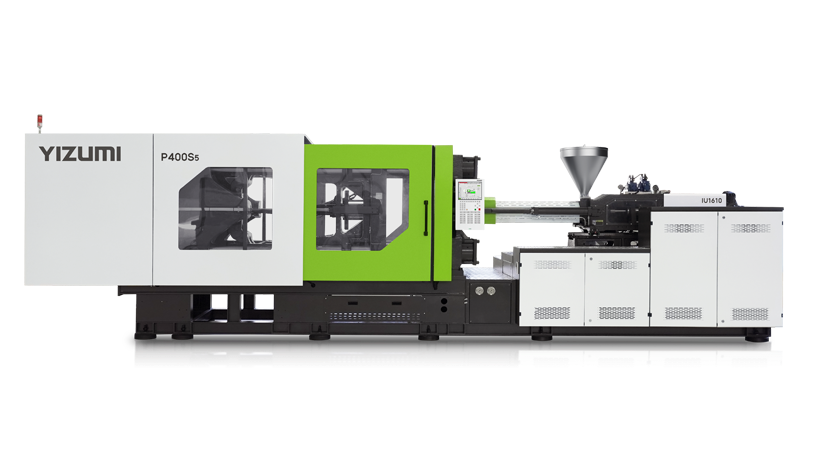
PS5 Series High-Speed Injection Molding Machine
5. Make Sure Screw Recovery Is Not the Hidden Bottleneck
Screw recovery should ideally finish while the part is cooling. If cooling is complete but the screw is still recovering, the machine is delaying the next cycle.
Common causes include:
· Screw size not matched to shot weight
· Back pressure set too high
· Screw speed too low
· Poor feeding stability
· Incorrect barrel temperature profile
· Worn screw or barrel
· Material drying or flow problems
For large shot weights, engineering plastics, packaging applications, and high-output production, plasticizing capacity should be checked before buying a machine. A machine selected only by clamping force may still limit output if screw recovery cannot keep up.
6. Reduce Mold Movement and Ejection Losses
Not all wasted time comes from plastic cooling. Mechanical movements can also add unnecessary seconds.
Mold Stroke
A common mistake is opening the mold farther than needed. The mold only needs enough space for safe ejection or robot take-out. Extra travel adds time every cycle. Review whether the mold open position can be reduced while still allowing:
· Safe ejection
· Robot access
· Part clearance
· Mold protection
· Operator safety
For high-volume production, even small improvements add up quickly.
Ejection
If parts stick, operators usually slow the process down. Better draft angles, smoother release surfaces, correct ejector layout, air assist, and stable mold temperature can reduce ejection delay. If multiple ejection strokes are used, confirm whether they are truly necessary.
Automation
Robot movement should be synchronized with the machine. The robot path should be as short as possible, and the mold should close as soon as the robot clears the safety zone.
YIZUMI provides injection molding solutions across high-speed, electric, two-platen, multi-component, special-usage, and vertical injection molding machine categories, covering applications such as medical, auto parts, 3C electronics, and high-speed packaging. This allows manufacturers to match the machine, mold, process, and automation as one production system.
7. Choose the Right Injection Molding Machine
A cycle time problem is not always a parameter problem. Sometimes the machine is not matched to the product, material, mold, or output target.
For Thin-Wall Packaging
Thin-wall packaging requires fast injection, stable clamping, short dry cycle, efficient cooling, and smooth automation integration.
YIZUMI’s P-E Series high-speed injection molding machine offers 30–50% energy savings compared with standard models under applicable conditions, with a dry cycle time of 2–2.6 seconds and clamping forces from 200 to 350 tons.
For Precision and Clean Production
For medical, 3C electronics, and precision components, repeatability and control accuracy are just as important as speed.
YIZUMI’s FF Series electric injection molding machine is designed for automation and intelligent integration, supporting improved quality consistency and efficiency, with clamping forces from 900 to 13,800 kN.
For Large Parts
Automotive and large industrial parts require stable clamping, platen rigidity, sufficient mold space, and reliable long-cycle performance. In these applications, two-platen injection molding machines can provide advantages for large-tonnage production.
For Higher Output Per Cycle
Sometimes the best way to improve productivity is not to make each cycle slightly faster, but to produce more parts per cycle. Stack mold technology can improve efficiency by 30–80%, depending on the production process, while reducing demand on equipment, operators, and floor space.
Common Mistakes to Avoid
Cutting Cooling Time Too Early: If cooling time is reduced before the part is stable, defects may appear after ejection. Always verify dimensions, appearance, warpage, and part weight.
Increasing Injection Speed Without Checking Venting: Poor venting, small gates, or unbalanced flow can make higher speed risky.
Ignoring Screw Recovery: If plasticizing is too slow, faster cooling will not improve output.
Buying a Faster Machine Without Reviewing the Mold: A high-speed injection molding machine cannot fully compensate for poor cooling, poor venting, excessive wall thickness, or an unsuitable mold structure.
Looking Only at Cycle Time: A shorter cycle that increases scrap is not a real improvement. Always compare cycle time with quality rate, energy use, labor, maintenance, and mold life.
How YIZUMI Supports Cycle Time Improvement
YIZUMI is not only an injection molding machine manufacturer, but also a molding equipment system and turnkey solution provider. The company reports more than 140,000 machines operating successfully, over 5,000 employees, and more than 200 million average annual R&D investment.
For customers, this matters because cycle time improvement often requires more than one machine parameter. It requires product review, mold understanding, process support, equipment selection, automation planning, and after-sales service.
YIZUMI’s overseas injection molding service team provides support 7 days a week and 16 hours a day, including installation and commissioning guidance, maintenance guidance, pre-sales technical support, problem analysis, and solution support.
Conclusion
Reducing injection molding cycle time starts with finding the real bottleneck, not simply increasing machine speed. By improving cooling efficiency, validating holding time, optimizing screw recovery, shortening mold movement, and selecting the right injection molding machine, manufacturers can produce more good parts per hour with stable quality, lower waste, and better ROI. YIZUMI helps match the machine, process, mold, and automation to your cycle-time target.