Medical Injection Molding for Prefilled Syringes: A Complete Guide
Abstract:
Medical injection molding for prefilled syringes links COP/COC, barrel design, precision molds, cleanroom control and validation. YIZUMI's FF200M medical injection molding machine combines all-electric control, intelligent weight monitoring and automation for consistent part quality.
Medical injection molding for prefilled syringes is the controlled production of polymer syringe barrels and related components that will later be assembled, sterilized, filled, and closed. A reliable solution combines the material, part design, mold, injection molding machine, robot, auxiliary equipment, cleanroom interface, inspection system, and production data, not just the molding press.
For a polymer barrel, small changes in roundness, inside diameter, wall thickness, flange geometry, or tip dimensions can affect downstream filling, stopper insertion, break-loose and glide force, leakage performance, dose delivery, and compatibility with safety devices or autoinjectors. The goal is therefore not simply to make a visually acceptable part. It is to establish a stable, traceable, and validatable process that repeatedly produces conforming components from every cavity.
What Does a Prefilled Syringe Molding Line Produce?
"Prefillable syringe" and "prefilled syringe" describe different stages of the product lifecycle.
Injection molding can produce a polymer barrel, plunger rod, finger flange, tip cap, needle shield, or another component. A barrel may then undergo assembly, washing where applicable, packaging, and sterilization before it is supplied as a ready-to-fill or prefillable syringe. It becomes a prefilled syringe only after the drug or flush solution has been filled and the container has been closed.
This distinction defines the scope of the molding project. An injection molding line does not replace formulation compatibility studies, washing, sterilization, aseptic filling, stoppering, container-closure integrity testing, or final product inspection. It must produce components capable of passing through those downstream operations while maintaining their dimensional and functional performance.
Which Materials Are Used for Polymer Syringe Components?
Material selection should start with the intended use, drug-contact status, storage period, sterilization route, and required mechanical and optical performance.
Polypropylene (PP)
Medical-grade PP is widely used for disposable syringe barrels, prefilled flush syringe components, plunger rods, and caps. It offers good chemical resistance, low density, and efficient processing. However, its shrinkage and crystallization behavior require balanced packing and cooling when barrel concentricity, sealing geometry, and dimensional consistency are critical.
Cyclic Olefin Polymer and Cyclic Olefin Copolymer (COP/COC)
COP and COC are considered for applications requiring high clarity, break resistance, accurate feature replication, or low interaction potential. The exact grade must be qualified against the drug formulation, storage conditions, sterilization method, and assembly process. Mold filling, cooling, and ejection also need to minimize residual stress, because stress can influence cracking and long-term performance.
Elastomers and Liquid Silicone Rubber (LSR)
Elastomers may be used for seals, needle shields, or soft components, and LSR can be appropriate for selected molded parts. Neither material should be treated as a universal replacement for a pharmaceutical plunger stopper. Formulation, coatings, extractables and leachables, closure integrity, and drug compatibility require separate evaluation.
A practical sequence is: define the product and drug-contact requirements, shortlist qualified grades, confirm sterilization compatibility, establish functional targets, and then finalize the part, mold, and machine.
Which Syringe Features Are Critical to Quality?
A useful molding specification connects each molded feature to its downstream function.
| Molded feature or result | Why it matters downstream | Typical control method |
| Barrel inside diameter, roundness, and straightness | Influences stopper sealing and break-loose/glide behavior | Cavity-specific dimensional measurement and capability analysis |
| Wall thickness and concentricity | Affects strength, optical appearance, cooling, and dimensional stability | Section measurement, vision inspection, and process monitoring |
| Tip and sealing geometry | Influences cap or needle fit and leakage performance | Dimensional inspection plus assembly and leak testing |
| Flange and external interfaces | Affects filling-line handling and compatibility with safety devices or autoinjectors | Gauge, vision, and functional fit checks |
| Gate quality, flash, short shots, burns, and black specks | Can affect assembly, cleanliness, appearance, and reject rate | Automated vision inspection and controlled part segregation |
| Part weight and cavity balance | Provides an early signal of filling or packing drift | Cavity-resolved weight checks and machine trend data |
Container-closure integrity is a system-level result. A dimensionally conforming barrel is necessary, but final integrity also depends on the stopper, front closure, assembly settings, sterilization, filling process, and drug product.
How Does Injection Molding Affect Syringe Barrel Quality?
The four main stages of the molding cycle directly influence syringe performance.
1. Clamping
The machine must keep the precision mold closed while maintaining platen and mold stability. Insufficient or uneven clamping can contribute to flash, venting problems, and cavity imbalance. Excessive clamping force can waste energy and accelerate wear without improving the part.
2. Injection and Holding
The melt must fill thin and deep barrel features without excessive shear, trapped gas, burns, or core deflection. A controlled velocity profile, transfer point, pressure limit, and holding stage are more useful than simply specifying the highest possible injection speed.
3. Cooling
Cooling often determines the final geometry and cycle time. Uneven mold temperature or insufficient cooling can cause ovality, warpage, variable shrinkage, and changes at sealing interfaces. Multi-cavity systems need balanced water circuits and monitored flow and temperature—not just a nominal mold temperature setting.
4. Ejection and Part Handling
The part must be released without scratches, deformation, or uncontrolled contact. A robot can remove parts using repeatable force and motion, maintain cavity order, and transfer them directly to inspection or packaging. This is especially valuable for clear barrels and other components with sensitive optical or sealing surfaces.
For a multi-cavity mold, an acceptable average can hide a weak cavity. Process qualification and routine monitoring should therefore examine cavity-specific weight, critical dimensions, appearance, and functional results. A robust process window is more valuable than a single successful trial at one setpoint.
How Do You Select a Medical Injection Molding Machine?
Machine selection should be based on the complete molding cell and the validated process window. The main inputs are:
1. Part drawing, nominal volume, part weight, and projected area
2. Resin grade, colorant or additive policy, and drying requirements
3. Mold dimensions, cavity count, hot-runner design, and mold actions
4. Required injection pressure, injection rate, plasticizing capacity, and shot size
5. Clamping force, platen layout, tie-bar spacing, opening stroke, and daylight
6. Target cycle time and annual good-part output
7. Robot, inspection, assembly, and packaging interfaces
8. Cleanroom layout, utilities, maintenance access, and data requirements
The selected injection unit should provide a suitable shot-size window for the total molded shot, including parts and runner where applicable. The clamping unit must accommodate both projected area and cavity pressure while fitting the physical mold. Machine speed matters, but repeatable pressure, position, plasticizing, mold movement, and automation synchronization are usually more important to long-term capability.
How YIZUMI FF200M Supports Prefilled Syringe Molding
Prefilled syringe barrels combine thin-wall filling, long flow paths, optical requirements, and sealing features in one part. To maintain barrel roundness and dimensional consistency across a multi-cavity mold, the molding machine must coordinate injection, holding, plasticizing, mold movement, and ejection with repeatable control. Clean handling and stable part transfer are equally important once the mold opens.
YIZUMI developed the FF-M Series medical injection molding machine for plastic medical consumables that require precision, cleanliness, efficiency, and automation. Within this series, the FF200M provides 2,000 kN of clamping force, 580 × 580 mm tie-bar spacing, a 220–560 mm mold-thickness range, and a 480 mm opening stroke. Multiple injection-unit configurations allow the machine to be matched to the resin, shot volume, injection pressure, and mold design of the specific syringe project.
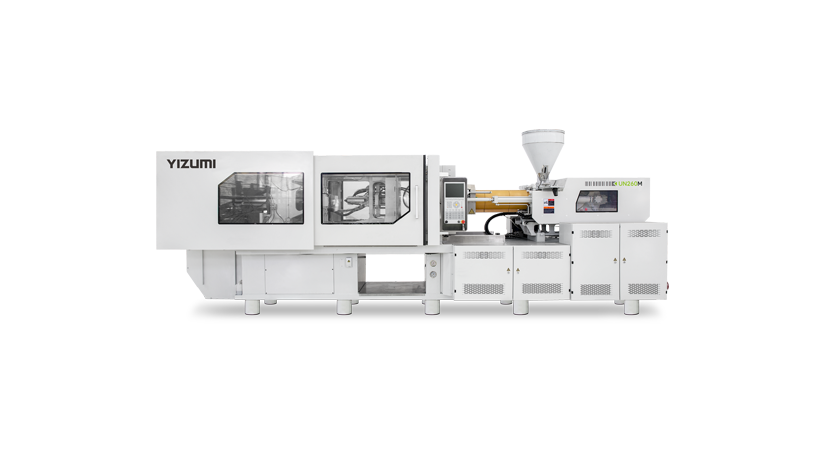
FF-M Series medical injection molding machine
The FF200M injection molding machine combines several technologies that address practical prefilled syringe molding requirements:
A cleaner mold area: the Tie-Bar Free clamping structure avoids contact between the platen and tie bars and removes the need for lubricating oil on the tie bars. The all-electric drive configuration further reduces hydraulic-oil exposure around the molding process.
Stable filling and holding: closed-loop injection-pressure control provides injection and holding-pressure stability of ±0.1 MPa under applicable operating conditions. This supports controlled filling and packing across multiple cavities.
Repeatable mold movement: the linear-guide structure provides guide accuracy of up to 0.02 mm and mold opening and closing repeatability of up to ±0.03 mm, supporting stable ejection and robot takeout.
Faster control response: YIZUMI's Servo Direct Control technology reduces the control cycle from 2–4 ms to 0.125 ms, improving the response of position, pressure, and movement control.
Process consistency: intelligent weight control monitors the molding process and dynamically adjusts parameters to reduce the influence of changes such as mold temperature and material behavior. This helps limit part-weight variation and identify process drift earlier.
Integrated production management: process-quality control, statistical process control, quality sorting, programmable I/O, robot communication, and production-data functions help connect molding, inspection, and traceability within one production cell.
For syringe manufacturers, these functions are intended to support a wider stable process window and more consistent cavity-to-cavity results. Final machine selection and production performance still need to be verified with the actual COP or COC grade, mold, auxiliaries, inspection system, cleanroom interface, and validated process.
What Should the Complete Molding Cell Include?
A prefilled syringe component line should be engineered as one system:
· Closed material handling and resin preparation appropriate to the qualified grade
· Precision multi-cavity mold with balanced filling, venting, and cooling
· Correctly sized medical injection molding machine
· Robot takeout that preserves part geometry and cavity traceability
· Controlled conveyor or transfer system
· Automated inspection for critical visual and dimensional defects where feasible
· Cavity and batch segregation for nonconforming parts
· Packaging or protected transfer to the next controlled operation
· Mold-temperature control, water-flow monitoring, and other qualified auxiliaries
· Production records linking the material lot, machine cycle, cavity, process data, and inspection result
YIZUMI describes its medical-consumables solution as covering process and mold analysis, equipment selection, production-line and automation planning, installation, training, preventive maintenance, and equipment upgrades.
Common Planning Mistakes
· Maximizing cavity count without checking the entire cell. Cooling, robot speed, inspection throughput, packaging, and mold maintenance can become the real bottlenecks.
· Choosing a machine from clamping force alone. Shot size, injection pressure and rate, platen layout, mold dimensions, plasticizing, and automation interfaces are equally important.
· Maximizing injection speed without a product-based process study. Excessive speed can increase shear, burns, flash, trapped gas, core movement, and residual stress.
· Using average data for a multi-cavity mold. Cavity-specific trends are needed to detect imbalance and localized wear.
· Treating cleanroom-compatible equipment as a sterile process. Environmental classification, bioburden control, sterilization, and aseptic filling are separate responsibilities.
· Comparing quotations only by machine purchase price. Unit cost also depends on cycle time, uptime, yield, energy, labor, floor space, maintenance, changeover, inspection, and material loss.
Information to Prepare Before Requesting a Proposal
To receive a useful technical proposal, provide:
1. 3D and 2D part drawings, nominal syringe volume, and tolerance requirements
2. Resin manufacturer, exact grade, color or additive restrictions, and drug-contact status
3. Intended sterilization method and downstream process flow
4. Part weight, runner concept, and preliminary mold design if available
5. Target cavity count, cycle time, annual good-part output, availability, and scrap assumptions
6. Critical dimensions, cosmetic limits, and required functional tests
7. Cleanroom class and contamination-control requirements
8. Robot, inspection, assembly, packaging, and material-handling scope
9. Traceability, data retention, user access, and system-integration requirements
10. FAT, SAT, IQ/OQ/PQ, training, documentation, and validation responsibilities
FAQ
Q1. Can injection molding produce a complete prefilled syringe?
A: Injection molding produces polymer barrels and related components. Filling, stoppering, closure, sterilization or aseptic processing, and final inspection require additional qualified operations.
Q2. Is PP or COP better for a prefilled syringe barrel?
A: Neither is universally better. PP can be efficient for disposable and flush-syringe applications, while COP or COC may be selected for demanding clarity, dimensional, break-resistance, or interaction requirements. The decision must be based on the formulation, storage period, sterilization, assembly, and functional tests for the specific product.
Q3. Why use an all-electric medical injection molding machine?
A: All-electric machines provide independently controlled servo movements, repeatable position and pressure control, and reduced hydraulic-oil exposure around the molding process. Clean production still depends on the complete cell design and operating controls.
Q4. How is prefilled syringe molding output calculated?
A: Theoretical hourly output equals cavity count multiplied by 3,600 and divided by cycle time in seconds. Real good-part output must also include availability and yield.
Conclusion
Medical injection molding for prefilled syringes demands precise material selection, balanced molds, stable dimensions, clean handling, automated inspection and traceable process control. PP, COP, and COC must be matched to drug contact, sterilization and functional needs. YIZUMI's FF200M electric medical machine combines servo precision, intelligent weight control and cleanroom-oriented automation, while its 32-cavity COP solution supports consistent barrel quality and efficient production.