Automotive Injection Molding: Large Molds, Stable Processes and Automation
Abstract:
Discover how automotive injection molding machines handle large molds, maintain stable processes, reduce warpage, and integrate automation for reliable, efficient production, from machine selection and process control to informed purchasing decisions.
Automotive injection molding is not simply a matter of melting resin and filling a mold. For a purchasing team or process engineer, the real question is whether a complete production cell can repeatedly make qualified parts at the required cycle time, cost and traceability level.
That challenge grows as parts become larger, thinner, more highly decorated or more integrated. A bumper requires substantial mold space and a long robot part pick-up path. A transparent lamp component needs precise plasticizing and contamination control. An EV connector may combine engineered resin, metal inserts and automated inspection.
Each application requires a different balance of clamping structure, injection performance, process control and automation. This guide explains what to evaluate before investing in an automotive injection molding machine—and why tonnage and purchase price alone are not enough.
Why Automotive Manufacturers Use Injection Molding
Injection molding supports high-volume production of parts with integrated ribs, bosses, clips, textures and mounting features.
| Vehicle area | Common molded parts | Main production priorities |
| Interior | Dashboards, door panels, consoles and pillar trims | Surface quality, low warpage and multi-material integration |
| Exterior | Bumpers, grilles, fender liners and spoilers | Large mold capacity, dimensional stability and automated handling |
| Lighting | Lenses, bezels, light guides and housings | Optical quality, precise injection and contamination control |
| Under the hood | Covers, ducts, reservoirs and brackets | Heat resistance, glass-fiber processing and reliable dimensions |
| EV and electrical | Battery covers, busbars, connectors and sensors | Flame-retardant materials, insert molding and traceability |
Lightweighting is one reason polymers and polymer composites remain important in vehicle design. The U.S. Department of Energy reports that a 10% reduction in vehicle weight can improve fuel economy by approximately 6%–8%. It also notes that lightweight materials can help offset the mass of batteries and electric motors in electrified vehicles.
However, replacing metal with plastic creates value only when the molded part meets its mechanical, dimensional, appearance and lifecycle requirements. Machine selection should therefore begin with the part and mold—not with a preferred machine model.
Large Automotive Molds: Tonnage Is Only the Starting Point
Calculate the Required Clamping Force
Required clamping force depends mainly on projected area, expected cavity pressure, cavity count and a suitable process margin.
An undersized machine can allow the mold to separate, producing flash and unstable dimensions. An oversized machine can increase capital cost, energy use and mold-loading risk.
The calculation should use the actual resin, flow length, gate design and filling study. A general rule of thumb is not a substitute for application data.
Check Mold Space in Three Dimensions
Before choosing a machine, confirm:
· Mold dimensions and total weight
· Platen dimensions and tie-bar spacing
· Minimum and maximum mold thickness
· Opening stroke, daylight and ejector stroke
· Core-pull requirements
· Robot pick-up
· Crane capacity, floor loading and mold-change route
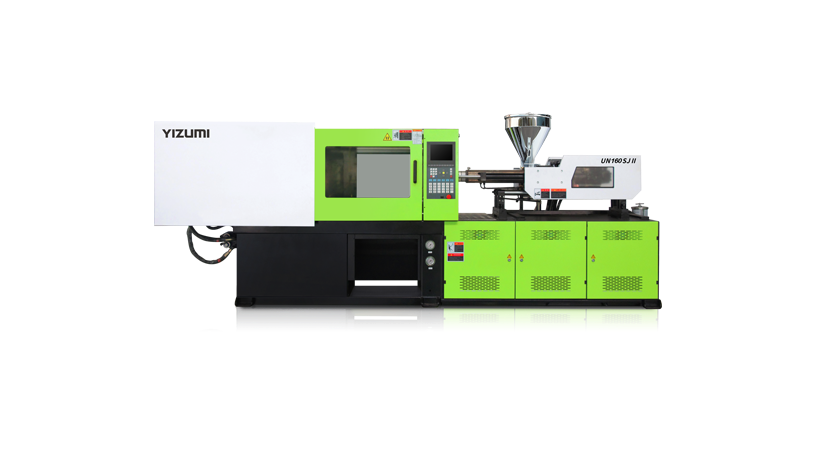
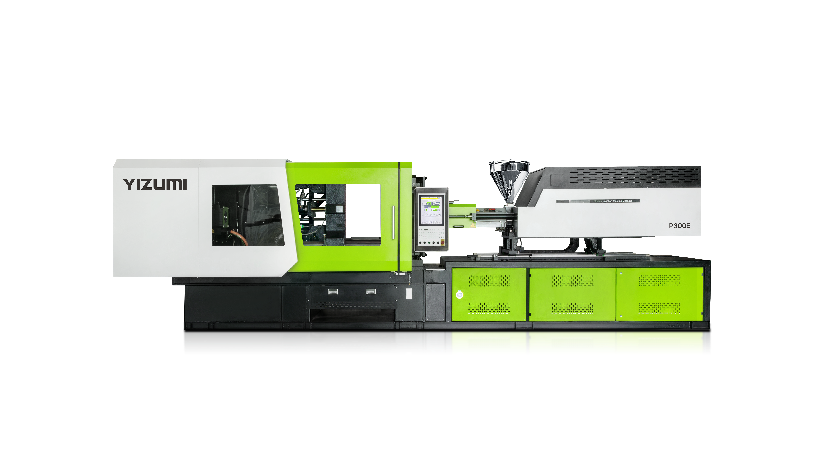
For bumpers, door panels and structural housings, a two-platen injection molding machine can provide generous mold space and opening stroke. YIZUMI’s D1S Series supports processes including injection-compression molding, FoamPro microcellular foaming and long-glass-fiber molding.
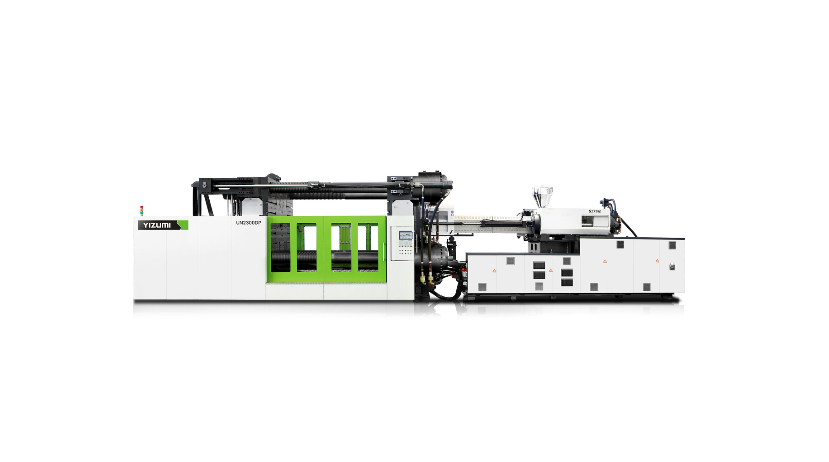
DP Series Two-platen Injection Molding Machine
Match the Injection Unit
The injection unit must deliver adequate shot volume, pressure, speed and plasticizing capacity. Plasticizing should finish without extending the target cycle, and the shot should operate within a stable portion of the barrel capacity.
A larger screw is not always better. It may provide higher shot capacity but lower resolution for smaller shots. Abrasive glass-fiber materials may require wear-resistant screw and barrel configurations, while transparent PC or PMMA parts need careful residence-time and contamination management.
Process Stability: Define It with Data
"High precision" and "stable production" are meaningful only when connected to measurable variables. A stable automotive process should maintain approved quality across cycles, shifts, material lots and normal environmental changes.
Manufacturers should monitor at least:
· Fill time and V/P transfer position
· Peak injection pressure and cushion
· Plasticizing time
· Melt and mold temperature
· Holding pressure and holding time
· Cavity-pressure profile where required
· Cycle time and part weight
· Critical product dimensions
· Scrap rate, Cp and Cpk
These signals help identify whether a defect originates in the machine, mold, material or auxiliary system.
A changing fill time with stable machine settings may indicate viscosity or temperature variation. An unstable cushion may point to non-return-valve behavior or inconsistent feeding. Warpage may result from asymmetric filling, uneven cooling, molecular orientation or premature ejection—not simply insufficient holding pressure.
Machine controls should make production information easy to record and analyze. On the YIZUMI D1S Series, published features include process-parameter change curves, production data control and statistical process control. The series also specifies adaptive PID barrel-temperature control accuracy up to ±0.5°C.
For applications requiring fast, precise movements, all-electric technology may be appropriate. YIZUMI modular configurations with injection speeds of approximately 160–500 mm/s and injection and mold-motion position accuracy within 0.03 mm, depending on the selected configuration.
A successful sample is not the same as a capable process. Before the factory acceptance test, define the production material, mold, target cycle, consecutive run duration, quality limits and process-capability target.
Automation Should Be Designed as Part of the Cell
Automation works best when it is planned with the machine and mold rather than added after installation.
A typical automotive molding cell may combine:
- 1. Material drying, conveying and dosing
- 2. Injection molding
- 3. Robot pick-up
- 4. Gate cutting or trimming
- 5. Metal insert loading
- 6. Vision, weight or dimensional inspection
- 7. Assembly or protective-film application
- 8. Part identification and traceability
- 9. Reject isolation
- 10. Packing or transfer to the next process
For large flexible parts, end-of-arm tooling must support the component without marking or distorting it. Vacuum confirmation, part-presence sensing and collision protection reduce the risk of leaving a part in the mold.
For insert-molded electrical parts, vision systems can verify insert position before molding and inspect the completed part afterward.
YIZUMI develops plastics injection molding automation for handling, surface planeness testing, film application and automotive trim processes. Its machine platforms provide communication interfaces and extensible I/O for auxiliary equipment and automated sequences.
Buyers should specify:
· Target cell cycle and permitted unplanned stops
· Part-removal confirmation
· Reject-handling logic
· Product changeover time
· Safety interlocks
· MES or quality-system data exchange
· Recovery procedure after interruption
· Responsibility boundaries among suppliers
A faster robot has limited value if the cell frequently stops because of poor gripping, unstable cooling or unclear fault recovery.
Choosing the Right Machine Architecture
Two-Platen Injection Molding Machines
Two-platen machines suit large molds, long opening strokes and high-tonnage parts such as bumpers, dashboards, door panels and EV housings.
Their compact clamping structure can also help manufacturers use factory space more efficiently while maintaining sufficient room for large molds and automated part removal.
Electric Injection Molding Machines
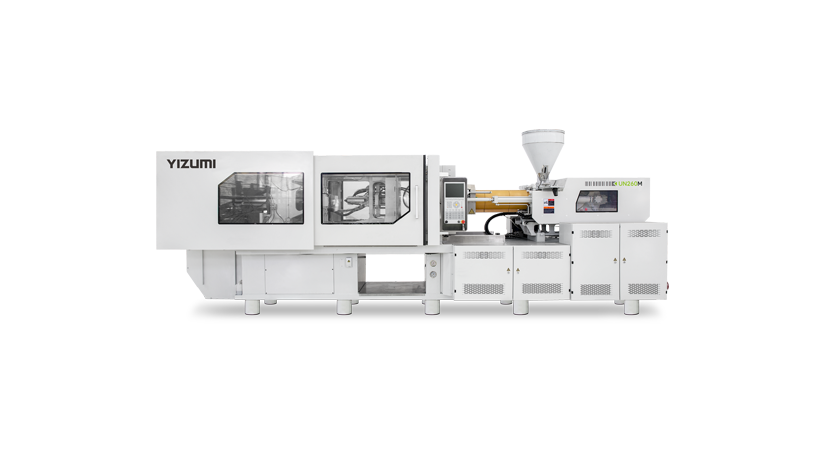
Electric machines suit precision parts requiring responsive motion, repeatability and clean operation. Typical applications include lighting components, connectors, sensors and smaller technical parts.
They should be evaluated according to actual injection-pressure, speed, mold-size and parallel-movement requirements rather than being selected only because they are electric.
Multi-Component Injection Molding Machines
Multi-component machines can combine colors, hard and soft materials, optical layers or functional surfaces in fewer production steps.
YIZUMI's two-platen multi-component range is published with clamping forces from 5,500 to 34,000 kN.
Potential automotive applications include:
- · Multi-color vehicle lighting
- · Hard-soft interior trim
- · Decorative and functional surfaces
- · Seals integrated into rigid components
- · Parts combining optical and structural materials
Vertical Injection Molding Machines
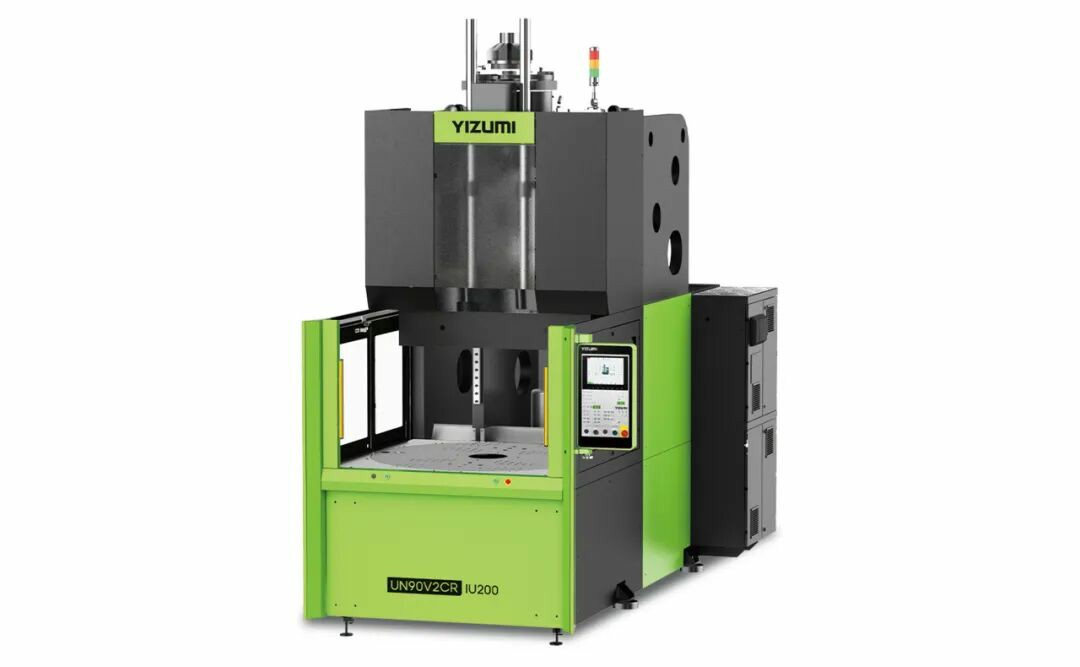
A vertical injection molding machine is useful when gravity-assisted positioning helps hold metal inserts in place.
Automotive applications include busbars, connectors, sensors, coils and overmolded electrical components. Rotary or shuttle-table configurations may allow insert loading and molding to take place in parallel.
The final machine choice must reflect the complete application. A machine suited to a bumper may be inefficient for a precision connector, while a high-speed precision machine may not provide enough mold space for a large trim part.
Automotive Production Evidence
Industrial references show whether a machine platform can scale beyond a demonstration cell.
For an electric-vehicle center-console frame, YIZUMI's FoamPro microcellular molding solution was used to reduce weight while controlling warpage for mass production.
These cases underline one point: machine hardware alone does not guarantee success. Process development, material preparation, mold design, automation and service support must operate as one system.
A Buyer's Checklist Before Requesting a Quotation
Prepare the following information before contacting an injection molding machine manufacturer:
- · 2D and 3D part data
- · Resin grade, additives and recycled-content requirement
- · Part weight, projected area and wall-thickness range
- · Mold dimensions, weight, cavity count and hot-runner details
- · Core pulls and special mold actions
- · Annual production volume and target cycle time
- · Appearance, dimensional and process-capability requirements
- · Automation and downstream-process scope
- · Plant utilities and proposed cell layout
- · Documentation, training and service-location requirements
Automotive suppliers operate within demanding quality systems. IATF 16949 is the central automotive quality-management standard, supported by customer-specific requirements and certification rules.
Equipment purchasing should therefore consider process-data retention, change control, measurement traceability, preventive maintenance and reaction plans—not only nominal machine output.
Build the Production Cell Around Your Part
The best automotive injection molding solution is not necessarily the machine with the highest tonnage, fastest injection speed or lowest purchase price.
It is the production cell that:
- · Fits the mold correctly
- · Processes the selected material reliably
- · Holds a validated process window
- · Supports the required automation
- · Protects the mold and product
- · Records the necessary production data
- · Delivers the lowest sustainable cost per qualified part
YIZUMI provides injection molding machines, process technologies, automation and application support for automotive production. Its portfolio includes two-platen, all-electric, multi-component and intelligent servo-hydraulic platforms.
YIZUMI's Testing and Application Center covers approximately 7,500 m² and includes more than 40 sets of testing equipment. The company reports CNAS accreditation for testing and calibration.
For a machine recommendation, provide the part drawing, resin, mold dimensions, mold weight, annual volume, target cycle and automation requirements. YIZUMI's engineering team can then review clamping force, injection-unit size, mold compatibility, process options and cell layout before preparing a technical proposal and quotation.
FAQ
Q1. What is automotive injection molding?
A: Automotive injection molding is a high-volume manufacturing process used to produce plastic vehicle components. Polymer material is melted, injected into a precision mold, cooled , and the finished part is then ejected. It is widely used for dashboards, bumpers, lighting components, connectors, under-the-hood parts and EV components.
Q2. How does automotive injection molding work?
A: Plastic pellets are dried when required, melted inside the machine barrel and injected into a closed mold. Holding pressure compensates for material shrinkage, while the cooling system solidifies the part. The mold then opens, and the finished component is removed manually or by a robot before the next cycle begins.
Q3. How is clamping force calculated for injection molding?
A: Required clamping force is mainly determined by the total projected area of the molded part and runner system multiplied by the expected cavity pressure. Material flow, wall thickness, gate design and cavity count also affect the result. Use actual application data or mold-flow analysis instead of relying only on a general tonnage rule.
Q4. What causes warpage in injection-molded automotive parts?
A: Warpage is usually caused by uneven shrinkage. Common sources include unbalanced filling, non-uniform wall thickness, uneven mold cooling, incorrect gate position, material orientation, inconsistent mold temperature and premature ejection. Increasing holding pressure alone may not solve the problem if the root cause is part design or cooling imbalance.
Q5. How can warpage be reduced in large automotive parts?
A: Start with balanced part geometry, gate design and cooling circuits. Then optimize melt temperature, mold temperature, filling speed, V/P transfer, holding pressure, holding time and cooling time. Process data should be reviewed together because changing one parameter may improve warpage while creating flash, sink marks or excessive cycle time.